City of Hillsboro, OR
Home MenuCommunity » Community Resources
Immigration Resources
The City of Hillsboro is committed to supporting our community and is sharing information and resources to support members of our community who may be negatively impacted by ICE.
Sharing these resources is part of the City's overall ICE Response Plan, which identifies actionable steps to support community members and businesses.
We will review and update the resources and information on this page on an ongoing basis. Latest update: March 18, 2026.
The content on this webpage is for general informational purposes only and does not constitute legal advice nor serve as a substitute for legal advice. Anyone in need of legal advice should seek the help of an independent, trained, and licensed attorney.
This webpage includes links to outside, third-party websites. The City of Hillsboro does not incorporate any content on third-party websites by reference. Sharing links on this page does not constitute or imply the City’s endorsement, sponsorship, or recommendation. We do not maintain or control these sites and accordingly make no guarantee concerning the accuracy, reliability, or currency of the information found there.
Use of this website and any outside links is at your own risk, and the City of Hillsboro is not liable for any damages arising from their use.
Navigate to resources on this page:
Urgent Concerns & Locate Loved Ones
For life-threatening emergencies, call 911.
Portland Immigrant Rights Coalition (PIRC) Hotline
Call the 24/7 Portland Immigration Rights Coalition Hotline at 888-622-1510 with urgent immigration concerns, including:
- You are witnessing ICE activity (suspected or confirmed)
- You have witnessed or have information about an ICE detention
- You’re looking for a missing loved one
The Portland Immigrant Rights Coalition provides updates on verified ICE activity on the PIRC website and WhatsApp Channel in Spanish: Información sobre inmigración en Oregon.
The PIRC Hotline is staffed by volunteers who are working around the clock to help you:
- Find an immigration attorney
- Request accompaniment for check-ins, immigration court hearings, appointments, and other mandatory appointments
- In certain circumstances, mobilize the community if someone in you family has been detained
More Ways to Contact PIRC
- Text the hotline with nonurgent issues, such as:
- Questions about resources that aren't needed within 24 hours
- Photos of possible ICE sightings, license plates, etc.
- Questions about resources that aren't needed within 24 hours
- Non-Emergency Voicemail Line: 971-940-9053
- General Email: PIRCPDX@gmail.com
- Volunteer Inquiries: Volunteers@PIRCOregon.org
- Press Inquiries: Press@PIRCOregon.org
The new PIRC Resource Center is located in Portland near the main ICE office for Oregon. The resource center supports people attending check-ins at the ICE office and provides resources for locating and helping a recently detained loved one.
- Download and print the PIRC Resource Center flyer - in English.
- Descargar y imprimir el volante sobre el Centro de Recursos de PIRC - en español.
Contact
PIRC Resource Center
4122 S. Moody Ave., Portland, OR
Accessible via Bus Routes 35 & 40, Streetcar NS.
Paid street parking is available.
Walk-In Support:
Monday through Friday, 7:45 am to 12 pm
Call 971-940-9053 for availability after 12 pm.
Support for Check-Ins
Volunteers in maroon vests carry clipboards to collect basic information (name, emergency contact, A-number) for people attending check-ins at the ICE office.
If you do not exit the building in two hours, PIRC will connect you to legal support and notify your emergency contact. Information is only shared with lawyers in the event of detention and is destroyed daily.
Support for Detentions
Resources are available to those seeking information and support for a recently detained loved one. We partner with ECO for legal referrals.
Know Your Rights With Immigration Enforcement
Everyone in the U.S. has constitutional rights, regardless of immigration status. Learn more about your rights as an immigrant, in various scenarios, and how to express them.
Information provided by the Immigration Legal Resource Center.
Red cards are provided in 56 languages on the Immigration Legal Resource Center website and distributed through local community-based organizations, nonprofits, volunteers, businesses, and private attorneys. These cards are available to citizens and noncitizens alike.
Red Cards: Front Side
The front side of the red card reminds you of your constitutional rights, as listed below.
- Do not open the door for an immigration agent.
- Do not answer any questions from an immigration officer if they try to talk to you. You have the right to remain silent.
- Do not sign anything without speaking to a lawyer first. You have the right to speak to a lawyer.
- If you are outside of your home, ask the agent if you are free to leave and if they say yes, leave calmy.
- Give your red card to the agent. If you are inside of your home, you can show the card through a window or slide it under the door.
Red Card: Back Side
The back side of a red card is always in English and is meant to be presented to an immigration officer. This side reads:
I do not wish to speak with you, answer your questions, or sign or hand you any documents based on my 5th Amendment rights under the United States Constitution.
I do not give you permission to enter my home based on my 4th Amendment rights under the United States Constitution unless you have a warrant to enter, signed by a judge or magistrate with my name on it that you slide under the door.
I do not give you permission to search any of my belongings based on my 4th Amendment rights.
I choose to exercise my constitutional rights.
Information provided by PIRC.
Know Your Rights With Immigration Enforcement
Don't Open the Door
Communicate through the window or closed door. Immigration can only enter your home with an arrest warrant signed by a judge.
Remain Silent & Do Not Sign Anything
You have the right not to speak. Say out loud that you will not answer questions or sign any documents without a lawyer present.
Do Not Give Permission for Search
You have the right to refuse permission for immigration authorities or police to enter or search your car or person unless they have a warrant signed by a judge.
Take Photos, Video, and/or Notes
Inform the officer that you will be using your right to record. Take photos, record the interaction, and write down the details.
Report ICE Activity to the Community Hotline
PIRC will contact rapid response teams that will verify and document immigration activity and offer support to affected people.
Confirm News & Rumors
Do not share unverified information, as this only creates fear. Ask people sharing news about ICE to share their sources and have witnesses call PIRC to verify.
PIRC Hotline: 1-88-622-1510
View & Print the Know Your Rights Posters
Information Provided by the American Civil Liberties Union (ACLU).
Watch this video series, based on true stories, to learn what to do when ICE is outside our doors, is in our homes, stops us in our communities, and/or arrests us.
- Watch the We Have Rights videos in English.
- Mirar los videos de Tenemos Derechos en español.
- Videos are also available in Urdu, Arabic, Haitian Creole, Mandarin, and French on the ACLU website.
We Have Rights: When ICE is Outside Our Doors
This video will help you understand what your rights are if ICE agents come to your home and what you can to try to prevent them from entering.
We Have Rights: Inside Our Homes
This video outlines important information about what to do when ICE agents are inside your home, what your rights are, and what you can do to prepare for future immigration proceedings, should they occur.
We Have Rights: In Our Communities, In Our Streets
This video outlines what your rights are if ICE approaches you in your community, what to do in such a situation, and how it is your right to record such interactions if you see them happening to someone else.
Information & image below provided by the National Immigration Law Center (NILC), PIRC, and Latino Network.
-
What to Do if You are Stopped, Arrested, or Detained in English
- Qué hacer si usted está parado, o es arrestado o detenido por las autoridades de Inmigración en español
Be Ready
Practice. Standing up for your rights is hard. Practice saying these phrases out loud. This will make it easier to say them if you get stopped.
Memorize the phone numbers you might need to call in an emergency.
Carry a Red Card/Tarjeta Roja in your wallet.
If You are Stopped, Arrested, or Detained
- You do not have to talk to them or answer any questions. You can remain silent.
- If you do not have valid immigration status, do not talk and do not answer any questions.
- You can say, “I am using my right to remain silent”
OR- Give them your Know Your Rights Red Card.
- Stay calm. Do not run away or try to stop the agents.
- Record what is happening on your phone or ask someone else to do it.
- Ask them what government agency they are from while recording.
- Ask, “Am I free to leave?” If they say yes, walk away calmly.
If Immigration Knocks on Your Door
You do not have to let them in unless they show you a valid judicial warrant.
- Keep the door shut and locked.
- Ask for a badge or ID and why they are there, and what agency they are from. Remember, immigration agents can lie to you to get into your home. They may say they are investigating a crime or need to "talk" or "take a look around."
- Say, "You cannot come into my home without a judicial warrant."
- If they say they have a warrant, DO NOT open the door. Ask them to slide it under the door or show it to you through a window.
- A valid judicial warrant (pictured right) will be signed by a judge and must have the name and address for the person in question.
- Learn how to identify a valid judicial warrant and see an example judicial warrant with key elements highlighted. (English & español)
- Agents may show you an administrative warrant. Administrative warrants do NOT give federal agents authority to enter private places. See an example administrative warrant with key elements highlighted. (English & español)
- If it NOT valid, you can say, "This is NOT a valid warrant. You do not have my permission to enter."
- Learn how to identify a valid judicial warrant and see an example judicial warrant with key elements highlighted. (English & español)
- If you do let them in, you still have the right to remain silent.
Be Prepared: Safety Planning
Note: You can print the preparedness packets below — or other documents — at the Hillsboro Public Library at affordable rates. The first 20 pages in black & white are free. Our library staff can also help you complete and save digital documents in-person or over the phone. Visit a library location or call 503-615-6500 for assistance.
Information provided by Innovation Law Lab, National Immigration Law Center, and United We Dream.
Memorize the phone numbers of people you may need to call if you get arrested, like a relative, trusted friend, or a lawyer.
- Memorize the key hotlines you may need:
Portland Immigrant Rights Coalition: 1-888-622-1510
Equity Corps of Oregon: 1-888-274-7292
National Immigration Detention Hotline: Dial 9233# from a detention facility phone
- Determine which identity and immigration-related documents you will carry with you when you leave your home and how you will carry them.
- Disable facial recognition or fingerprint passwords on your phone and use written passwords.
- Make sure your photos and videos are being synced to the cloud (e.g. iCloud or Google photos) in case you record an interaction with ICE so that other people can access it.
- Talk to an immigration lawyer now. Ask about the risks and options in your particular situation. Ask them if you would qualify for release on bond or own recognizance if you were detained. See the Legal Resources section below.
- If you are a parent or caregiver, make a back up plan about how to provide care and protect your children if you are arrested. See the Protect Your Family Guide below.
Keep your important papers, like birth certificates and immigration papers, in a safe place. Tell a relative or friend where you put those papers so they can get them if needed.
- Make sure a relative or friend has your A-number, if you have one. An A-number is a 9-digit number that starts with an A and is on most immigration papers.
- Make a preparedness plan and share the resources on this webpage with friends and family so they find and assist you if you have been detained.
Information provided by the National Immigration Law Center.
Documents to Keep With You & What to Show Immigration Officers
Based on your situation, make copies of the documents listed below.
- Keep the originals in a safe place if they are not with you. Tell a relative or friend how to find them, if needed.
- Do NOT carry or show law enforcement anything that shows you were born outside the U.S., like a foreign passport. They can use that to try to deport you.
- Be ready. Find your situation below, practice, and be prepared.
- Important! If you are not being arrested, stay silent.
Valid Immigration Status
Carry: The law says you must carry with you your lawful permanent resident card or immigration papers that show your status.
Show: If law enforcement asks to see your papers, show them your copy.
Applied for Valid Immigration Status/Open Case
Carry: Have a copy of your immigration papers that show you applied for status or are appealing an immigration decision.
Show: If you get arrested, show your papers to the immigration agent.
Undocumented/Expired Immigration Status
If you do NOT have current immigration documents, but have been in the U.S. for at least two years, carry proof of you living here.
Carry:
- Your rental contract
- Church or school records with your address
- Mail sent to you at your home address, including the postmark that shows when it was mailed
- Other documents that show your name, a U.S. address, and date
Show: Show proof you have lived here for at least two years. This can protect you from being quickly deported without seeing a judge. If you can’t prove you’ve lived in the U.S. for more than two years, they can deport you without giving you a chance to see a judge.
Provided by Oregon Law Center & Latino Network
Protect Your Family is an essential guide that could assist you in creating a family plan for unexpected circumstances, such as a detention or removal by ICE or federal agents. It includes important documents and instructions to create a plan to protect your family.
- View & download the Protect Your Family Guide in English
- Mirar y descargar la Guía de Proteja Su Familia en español
Watch the video in Spanish for step-by-step instructions on how to complete the guide.
Video provided by Latino Network.
Information provided by Innovation Law Lab
Innovation Law Lab has developed this Know Your Rights, Responses, and Recourses guide for immigrants and supporting communities — both (1) to know your rights and (2) understand your options beyond those rights, recognizing the limitations of rights and the real possibility that they may be violated.
- View & download the Preparing for ICE Encounters: Know Your Rights, Responses & Recourses guide - in English
- Mirar y descargar la guía de Preparación para encuentros con ICE: Conozca sus Derechos, Respuestas y Recursos - en español
The goal is to help build knowledge so that potentially impacted individuals can make informed decisions about how to respond in the event of an ICE intrusion. To facilitate this process, the end of the guide includes a tool to develop a personal response plan to prepare for ICE encounters and know your options based on your individual circumstances.
Documenting & Reporting ICE Activity & Violations
Use the tabs below to learn how to document and report ICE Activity, report Oregon Sanctuary Promise Violations, or make a Federal Oversight and Accountability report.
- Report ICE Activity
- Report Oregon Sanctuary Promise Violations
- Report Concerns Related to Federal Actions
Information provided by PIRC and Witness, Inc.
Save & memorize the PIRC phone number & call the hotline if you are witnessing ICE activity or have information about an ICE detention.
PIRC Reporting Hotline: 1-888-622-1510
Email Videos: PIRCpdx@gmail.com
If you feel it is safe to do so, document ICE activity by recording a video with narration, taking photos, or by witnessing the activity and writing down the facts.
It is your legal right to film, as long as you don't interfere. However, ICE and other federal agents have targeted community members in different states, so it’s essential to assess your own risk and know your rights before you decide to film.
If you do film, focus on the ICE activity, and not the person being arrested or detained.
Remember to "Be CLEAR" as a guide for what to narrate, document, and report.
C - Count: How many agents, how many vehicles? Are they wearing badges or uniforms? Did they identify themselves?
L - Location: Cross streets, exact address, or nearby landmark like a business, park, or school.
E - Equipment: Vehicles, plates, and other equipment.
A - Actions: What are the agents saying or doing?
R - Report the Time & Date: Say this out loud on the video.
Watch the PIRC video or the Ojos En ICE video - en español to learn more.
Visit the Witness, Inc. Eyes on ICE webpage for extensive resources on how to safely and effectively document and report ICE and Border Patrol abuses against immigrants.
Information provided by the Oregon Department of Justice.
In Oregon, state and local government, including police, are not allowed to enforce federal immigration law unless they have a court order signed by a judge. If you or someone you know has been targeted in violation of Sanctuary Promise laws, report it.
Sanctuary Promise Hotline: 1-844-924-STAY (1-844-924-7829)
More than 240 languages are supported & relay calls are accepted.
Report Online in English: SanctuaryPromise.Oregon.gov
Línea Directa de Promesa de Santuario en español: 1-844-6-AMPARO (1-844-626-7276)
Reporte en línea en español: PromesaSantuario.Oregon.gov
When to report a Sanctuary Promise violation?
- If police question you about your national origin or immigration status.
- If you see state or local government or police collaborate with federal immigration authorities.
- If you see police working with ICE to coordinate traffic stops.
- If individuals who are in jail or on probation are denied services, benefits, or privileges based on their immigration status.
- If you are arrested in court or while you are traveling to or from court, without a court order signed by a judge.
- Not sure? Learn more online or call the hotline for more information.
Learn more about what it means to be a sanctuary state and sanctuary city below.
Information provided by the Oregon Department of Justice.
Make a Federal Oversight and Accountability Report
If you have information or concerns about possible violations of individual rights or actions that raise legal or constitutional issues, please share them with the Oregon Attorney General through the Federal Oversight and Accountability Reporting Form.
The Oregon Department of Justice continues to challenge unlawful government overreach and promote transparency and accountability in federal actions. Your report helps to document concerns, identify patterns, and better understand emerging issues.
Learn more on the Oregon Attorney General Federal Oversight website.
What To Do if You or Your Loved One Is Detained
The U.S. immigration enforcement system can be difficult and confusing, especially if you are in distress or you have experienced trauma.
Try to stay calm and focus on gathering information and getting legal help quickly.
Quick Help
- PIRC Hotline: Call 1-888-622-1510 or visit the PIRC Resource Center in Portland to report a detention and get support.
- ICE Detainee Locator: Search the ICE Detainee Locator to try to locate someone in custody.
- Tacoma NW Detention Center: If you think your loved one is detained at the Northwest ICE Processing Center in Tacoma, Washington, visit the facility's official website and see the PIRC People's Guide to Northwest Detention Center to learn how to confirm, get in touch, send money, or visit.
- ABA Hotline: If you think you are in a military facility (including Guantanamo Bay) for immigration reasons, call the American Bar Association Hotline at 855-641-6081.
- Legal Support: Visit the Legal Resources section below to connect with representation and support.
Information provided by Oregon Worker Relief.
Gather information.
Have your loved one’s full name, date of birth, country of birth, and their A-Number (Alien Registration Number) on hand.Find their A-Number.
The A-Number can be found in work permits, green cards, and USCIS documents, usually an eight or nine digit number. Keep this number as part of your Family Preparedness Plan.Call the PIRC hotline.
Report the detention to PIRC at 1-888-622-1510.Contact an immigration attorney.
It helps to have a legal attorney ahead of time. For more information, and for financial support with legal services, see the Legal Resources section below.Use your Family Preparedness Plan.
Contact childcare arrangements, inform of detention, and gather the documents you collected to share with the lawyer.Information provided by the Oregon Department of Justice, Oregon Law Help, Oregon Worker Relief, the National Immigration Law Center, and the National Immigrant Justice Center.
Please keep in mind that the U.S. immigration system is very complicated and changes without explaining to advocates and families the consequences of such changes. Please contact local advocates or legal service providers for the most up to date information.
Ask Them for Their A-Number & Country of Birth
- The A-Number starts with the letter A and has 9 numbers.
- ICE will give them this number upon arrest.
- If the person has filed a previous immigration application, it’s likely they will already have an A-Number on any documents from immigration.
Search the ICE Online Detainee Locator System (18 and Older)
Search the ICE Online Detainee Locator System using their A-Number & country of birth or using their full name, country of birth, and date of birth.
- They might not appear in the locator until it has been 48 hours since they entered detention. Search again if you do not find them.
- The locator only finds people if you put their name in exactly the same way it was entered by the immigration agent. You might need to try different versions of their name. The locator doesn't read special characters like á, í, ñ, or é. If a typo or mistake was made when their name was entered, you may not be able to locate them.
- Children 18 and younger do not show up in the online locator system.
- If a “zero record found” message comes up, the person could still be in a detention center due to the specifications above.
Contact the Tacoma NW Detention Center/Northwest ICE Processing Center (NWIPC)
When possible, please ask an attorney or advocate to do this on your behalf.
The closest ICE detention facility to Oregon is in Tacoma, Washington:
Phone: 253-779-6000
Website: Northwest ICE Processing Center
Physical Address: 1623 E J Street, Suite 2, Tacoma, WA
Contact the Main ICE Office in Oregon
People are sometimes held overnight at a local ICE office before being sent to a detention center.
Phone: 503-326-4165
Website: Main ICE Office for Oregon
Physical Address: 4310 S Macadam Avenue, Suite 300, Portland, OR
- The office may not answer the phone. You might need to call many times each day.
- Ask for the name and contact information for the officer in charge of your loved one’s case. This will be very important if you want to help them try to get out of detention.
More Resources for Finding People Who Have Been Detained
Lost in the U.S. Immigration Detention System Toolkit, provided by Freedom for Immigrants
- Immigration Detention System Toolkit -in English
- Instructivo del Sistema de Inmigración - en español
How to Find a Loved One After a U.S. Immigration Arrest, provided by the National Immigration Law Center
- How to Find a Loved One - in English
(also available in Arabic, Chinese – Simplified, Chinese – Traditional, Haitian Creole, Korean, Tagalog, and Vietnamese through the English link above)
- Cómo encontrar a un ser querido - en español
Know Your Rights: What to Do if You or a Loved One is Detained, National Immigrant Justice Center
- Detention Rights - in English
(also available in Arabic, French, and Haitian Creole through the English link above)
- Derechos de detención - en español
If Your Loved One is Detained, provided by Oregon Worker Relief
Information provided by Innovation Law Lab, American Bar Association, Freedom for Immigrants, and the National Immigration Law Center.
What to Know
- You have the right to remain silent.
- You have the right to access an attorney. If they tell you or a loved one that you cannot talk to a lawyer, contact:
- American Bar Association Commission on Immigration Detention Information Hotline
Dial 2150# from a detention facility phone.
Direct Phone Number: 202-442-3363.
Email: Family & friends can email IMMCenter@AmericanBar.org
- National Immigration Detention Hotline
Dial 9233# from a detention facility phone, Monday through Friday, 8 am to 8 pm
- American Bar Association Commission on Immigration Detention Information Hotline
- You have the right to receive visits from an attorney, your consulate, and your family.
- Based on your individual circumstances, you may have avenues to seek release from detention or continue fighting your immigration case.
What You Should Do:
During an arrest or detainment, say, "I want to speak to my attorney” or “I want to contact an attorney.” Continue asking for an attorney until you are allowed to contact one.
- Ask your attorney, and the immigration agents, if you have the right to be freed on recognizance, on bond, or on parole. If they say no, ask for a bond hearing with an immigration judge.
- Tell officials if you are the primary caretaker of a child or other loved one.
If that child or loved one is a U.S. citizen or permanent resident, say so.
- Ask to notify your family: “I would like to call my family so they know where I am.”
Make sure a relative or friend has your A-Number, if you have one. An A-Number is a 9-digit number that starts with an A and is on most immigration papers.
- Tell ICE if you are ill, pregnant, breastfeeding, or have other medical or mental health needs.
- If you are afraid to return to your country of origin, say so loudly and clearly to every agent you see. If you do not say you are scared, they may deport you without giving you a chance to see a judge or ask for asylum.
- If the government states that it plans to deport you to a country other than your country of origin, state your fear of being sent to that country.
- If you have lived in the U.S. for at least two years, tell an officer and show them proof of your living here. This can protect you from fast-track deportation.
- If you applied for status or are appealing an immigration decision, tell an officer and show them proof of your application or appeal.
Do NOT
- Do NOT lie or give false information.
- Do NOT sign any documents without talking to a lawyer first, especially any document that says, "Waiver," or "Stipulated Removal Order," or "Voluntary Departure Agreement"
The U.S. Immigration and Customs Enforcement (ICE) National Detainee Handbook provides an overview of the general rules, regulations, policies, and procedures that detainees are required to follow while in ICE custody. It also provides overview of the programs and services available while detainees are residing in an ICE-approved facility.
Information provided by the District of Columbia, U.S. Department of State, Freedom for Immigrants, National Immigration Law Center, and Latino Network
All immigrants in ICE detention centers have the right to contact their country’s consulate.
- Latino Network Embassy and Consulate Finder
(hay herramienta para traducir la página a español)
Consulates can help people find where a family member is detained, or even provide legal defense support. Be aware that consulates are required by law to be notified by United States federal, state and local government offices when one of their nationals is detained.
- Please note that consulates have varying degrees of efficiency, depending on their resources.
- Consulates will request a familiar relationship and/or permission from the detained person before providing information. Referring people in detention directly to consulates is a better practice and more time-efficient.
In the United States, foreign governments have embassies (a foreign government’s headquarters) in Washington, DC and consulates (branch offices) in other cities. Both embassies and consulates provide assistance to that country’s citizens in the United States.
Note: It is a person’s individual decision whether they also wish to reach out to their consulate. Individuals with asylum claims may not wish to do so.
Information provided by the Oregon Law lab.
After an arrest, the person may be released, held, or deported quickly.
- An ICE officer may decide to release or hold someone based on their criminal history and community ties.
- If ICE does not release the person, they will be taken to the nearest ICE office or a detention center.
- Most people detained by ICE in Oregon are sent to the Main Oregon ICE Office on Macadam Avenue in Portland and/or the Northwest Detention Center in Tacoma, Washington.
- In some cases, the person may be deported rapidly through expedited removal without a chance to see a judge or apply to stay in the United States.
- The only legal protection against rapid deportation is if the person fears they would be harmed if deported. If you are put in expedited removal and you fear you would be harmed in the country you are from, say that you are afraid clearly and out loud every chance you get. Learn more about expedited removal.
If they are released:
- They will receive a document called "Notice to Appear" with information about their case and why ICE is trying to deport them.
- It should also have the date, time, and location of their first court hearing.
- Sometimes, the hearing information is not correct. Check the hearing information online or call the immigration court hotline at 1-800-7108 to confirm.
If they are NOT released:
Their case may go one of two ways: they may be deported very quickly, or they may have a chance to fight their deportation in immigration court.
Find more information about what happens after an ICE arrest and how to protect yourself from expedited removal (being deported quickly) on the Oregon Law Help website.
Legal Resources & Immigration Court Cases
- Learn how to find low-cost immigration legal help through the Oregon Law Center.
- If you cannot afford an attorney, call the Equity Corps of Oregon (ECO) Hotline at 1-888-274-7292 — Monday through Friday, 9 am to 6 pm — to see if you qualify for free legal services. Learn more about how to enroll in ECO.
- If you can afford to hire a private lawyer, the Oregon State Bar Lawyer Referral Service can connect you with qualified immigration lawyers.
Oregon Law Center: Hillsboro Regional Office
Phone: 503-640-4115
Website: Oregon Law Center: Hillsboro Regional Office
Guided Help: Oregon Law Center Guided Help Tool
Oregon Law Center is a non-profit organization that provides free legal help to people struggling to make ends meet. Legal help is available in the areas of immigration & civil rights, housing law, farmworker law, family law, employment law, and administrative law. Bilingual English/Spanish staff members and interpreters are available.
Equity Corps of Oregon (ECO)
Call Center: 1-888-274-7292, Monday through Friday, 9 am to 6 pm
Website: Equity Corps of Oregon (ECO)
ECO offers access to lawyers, legal clinics, workshops, classroom-style instruction, mutual-aid support groups, support with filing fees and more. To be eligible for free legal services, you must live in Oregon, earn a household income below 200% of the federal poverty guidelines, and be at risk of deportation or need help with an immigration legal matter.
SOAR Immigration Legal Services - Hillsboro Office
Address: 862 SE Oak Street, Suite 3A, Hillsboro, OR
Open Tuesday, Wednesday, Thursday, 9 am to 12 pm and 1 to 4 pm
Phone: 503-384-2482, ext. 200
Email: SOARLegalHillsboro@EMOregon.org
Website: SOAR Immigration Legal Services - Hillsboro Office
SOAR's general legal program offers $50 legal consultations at their Hillsboro & Portland offices. If clients qualify for grant funded projects, they may provide free and low-cost legal services for eligible individuals.
Catholic Charities Immigration Legal Services
Phone: 503-542-2855
Enrolled clients should contact their representative to make an appointment.
Website: Catholic Charities Immigration Legal Services
Catholic Charities’ Immigration Legal Services (ILS) program is a nonprofit law program providing low-cost consultations and legal representation to immigrants and refugees throughout Oregon and southwest Washington. They focus on family reunification and assistance to the most vulnerable immigrants.
Safe Route Immigration by Lutheran Community Services Northwest
Phone: 206-901-1685
Locations & Support: Find an Office & Submit a Help Request
Website: Safe Route Immigration by Lutheran Community Services Northwest
Safer Route Immigration legal services to refugees and immigrants, with offices located Portland, Beaverton, McMinnville, and Salem, Oregon, along with Vancouver, Tacoma, SEA TAC and Seattle, Washington. Their egal department speaks several languages including English, Spanish, Ukrainian, Russian, Vietnamese, Bosnian, Dari, and Pashto, and provides interpreters across locations with capabilities in several Arabic and African languages.
Northwest Workers' Justice Project (NWJP)
Phone: 503-525-8454
Email: Email NWJP
Website: Northwest Workers' Justice Project (NWJP)
The Northwest Worker's Justice Project provides high quality legal support and education to workers and their organizations, focusing on low-wage workers' organizing rights, rights of immigrant workers, rights of contract, part-time, day haul, and temporary workers, and the effects of international trade. NWJP has limited resources and can only provide full representation to a small percentage of people who contact us. NWJP Staff is bilingual in English and Spanish.
CLEAR Clinic
Request Services: Complete an intake form
Website: CLEAR Clinic
The CLEAR Clinic is a nonprofit collective of legal workers who provide free legal services to Oregonians. Services include Court Record Relief, Housing Justice (Eviction Expungement & Tenant Advocacy), Immigration services, including free deportation legal defense, and Name & Gender-Market Changes.
Immigrant Connection PDX
Phone: 971-202-2073
Email: Info.ICPDX@gmail.com
Appointments: Schedule an appointment
Website: Immigrant Connection PDX
Immigrant Connection PDX is a church-based, low-cost, immigration legal services office located in east Portland that provides legal assistance to individuals who are seeking assistance with issues relating to immigration. A $40 office visit/legal consultation fee is due at your first appointment.
Oregon State Bar Problem Solvers: For People 13 to 17 Years Old
Phone: 503-684-3763 or 800-452-7636
Monday through Friday, 8:30 am to 5 pm
Website: Problem Solvers
Oregon lawyers volunteer as Problem Solvers to offer free legal information and advice to children. Any young person between the ages of 13 and 17 can call to request a referral to this program. Volunteer attorneys agree to provide a free thirty-minute consultation. There are a limited number of attorneys in the program. Call to find out about availability in your area.
Tips for Choosing a Legal Representative
Information provided by Oregon Law Help.
- Check their credentials.
Make sure the person helping you is a licensed lawyer or an "accredited representative" approved by the U.S. Department of Justice. Search them on the Oregon State Bar Membership Directory, American Immigration Lawyers Association Directory, or Department of Justice Recognition and Accreditation List.
- Ask questions.
Ask about their experience and fees you can expect.
- Get a free consultation.
Use a consultation to find out how an attorney or legal aid organization can help you.
American Immigration Lawyers Association (AILA) Directory
Website: Find an Immigration Lawyer
The American Immigration Lawyers Association has a directory of lawyers who are licensed to practice law, have professional liability insurance coverage of $100,000 or more, and took at least nine of hours of classes in the last year to stay up to date on immigration law.
Oregon State Bar Lawyer Referral Service
Phone: 503-684-3763 or 800-452-7636
Monday through Friday, 8 am to 5 pm
Request a Referral Online: Oregon State Bar Referral Request Form.
If you can afford to hire a private lawyer, the Oregon State Bar Lawyer Referral Service can connect you with qualified immigration lawyers. All referral service attorneys provide an initial meeting of up to 30 minutes for no more than $50. After the initial meeting, lawyers charge standard fees.
Oregon Law Help Legal Directory
Website: Oregon Law Help Legal Directory
Search the Oregon Law Help Legal Directory to search for organizations offering free or low-cost immigration legal services.
Information provided by PIRC, ECO, and Clear Clinic.
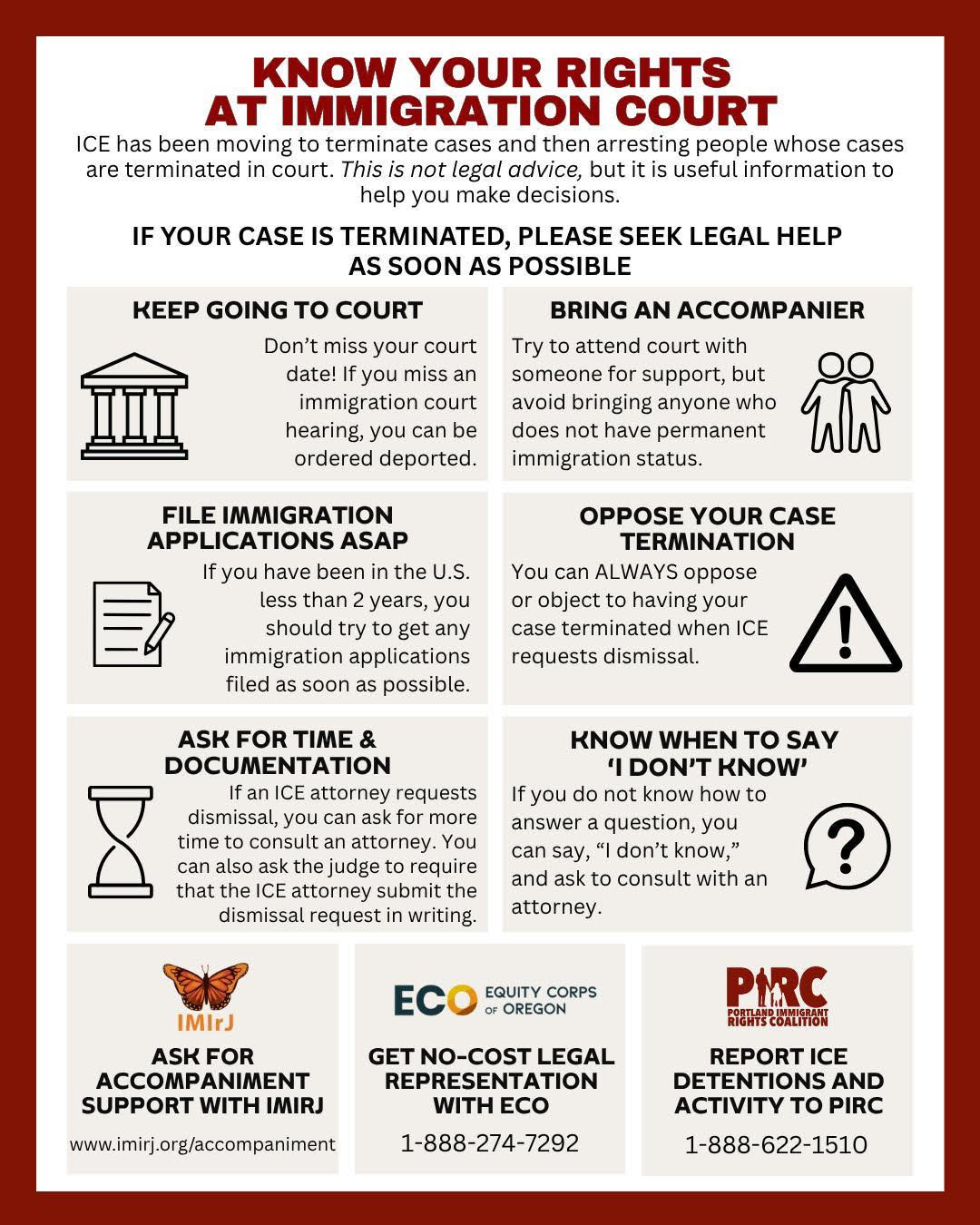
Know Your Rights at Immigration Court
PIRC, ECO, and CLEAR Clinic created a Know Your Rights Explainer for community members to review before attending immigration court.
- Read the full Know Your Rights When Going to Immigration Court Explainer, available in English & Spanish.
- View the PIRC Know Your Rights at Immigration Court flyer.
ICE has been moving to terminate cases, then arresting people who have their cases terminated.
If your case is terminated please seek legal help as soon as possible.
Keep Going to Court
Don't miss your court date! If you miss an immigration court hearing, you can be ordered deported.
Bring an Accompanier
Try to attend court with someone for support. Avoid bringing anyone without permanent immigration status. See the Accompaniment Program information below.
File Immigration Applications As Soon As Possible
If you have been in the U.S. less than two years, you should try to get any immigration applications filed as soon as possible.
Oppose Your Case Termination
You can ALWAYS oppose or object to having your case terminated when ICE requests dismissal.
Ask for Time & Documentation
If an ICE attorney requests dismissal, you can ask for more time to consult an attorney and ask the judge to require that the ICE attorney submit the dismissal request in writing.
Know When to Say, "I Don't know"
If you do not know how to answer a question, you can say, "I don't know," and ask to consult with an attorney.
Innovation Law Lab Guide to Immigration Court & ICE Arrests
Read the Innovation Law Lab's Guide to Immigration Court & ICE Arrests in Oregon to learn more about how to prepare.
Find the Status of an Immigration Court Case
Search the Executive Office for Immigration Review (EOIR) online case tracker or call the hotline at 800-898-7180. Hotline is available 24 hours a day, 7 days a week.
What to Expect When You Go to Immigration Court
Information provided by Oregon Law Help
If you are facing a deportation case in immigration court, it's normal to feel nervous or unsure. Many people feel scared or confused before their hearing. Understanding what to expect can help you feel more prepared and in control.
Read the Oregon Law Help Guide on What to Expect When you Go to Immigration Court.
U.S. Department of Justice Executive Office for Immigration Review Immigration Court Online Resource
A centralized location for information and resources about immigration proceedings before the Executive Office for Immigration Review (EOIR).
Accompaniment Program: Interfaith Movement for Immigrant Justice (IMIrJ)
Request Accompaniment: Submit an Accompaniment Form (bilingual English/Spanish)
Please provide at least two weeks to be paired with an accompaniment volunteer.
Trained volunteers walk side-by-side with individuals as they attend ICE check-ins, immigration court hearings, Intensive Supervision Appearance Program appointments, and other mandatory dates during their immigration process.
Find Support: Community Organizations
Connect with community and advocacy organizations that support immigrant rights, provide programs and services to empower Latine community members, and/or defend human rights and racial justice. The organizations below focus on immigrant services or serve Latino community members.
- Visit the City of Hillsboro's Community Resources webpage to find financial assistance programs, shelter, housing, and food access resources, healthcare resources, Veteran services, and more cultural community organizations.
Holistic Services for Latino Community Members & Immigrants
Adelante Mujeres
Adelante Mujeres provides holistic education and empowerment opportunities to marginalized Latina women and families to ensure full participation and active leadership in the community. Programs focus on education, leadership training, sustainability, mental health, and family engagement and include the Forest Grove Farmers Market & Cornelius Farmers Market.
Website: AdelanteMujeres.org
Phone: 503-992-0078
Facebook: Adelante Mujeres Facebook
Instagram: Adelante Mujeres Instagram
Centro Cultural (Centro)
Centro empowers Latino families and diverse communities by removing barriers, fostering well-being, and building power to achieve economic prosperity. Multigenerational and culturally-specific services include: K-12 STEAM education, workforce development, small business technical assistance, public engagement, civic advocacy, community health and wellness, transitional housing, and community-wide arts and cultural events.
Visit Centro's Immigration Resources webpage.
Website: CentroCultural.org (View in English or Spanish)
Phone: 503-359-0446
Facebook: Centro Cultural Facebook
Instagram: Follow Centro Cultural on Instagram
Immigrant & Refugee Community Organization (IRCO)
IRCO welcomes, serves, and empowers refugees, immigrants, and people across cultures and generations to reach their full potential. Holistic programs focus on asset & opportunity building, community safety & wellbeing, early learning, workforce & employment, and youth & academic programs. The organization offers language services, housing support, and hunger relief, among other services.
Website: IRCO.org
Phone: 503-234-1541
Facebook: IRCO Facebook
Instagram: IRCO Instagram
Youth & Family Services
Latino Network
A Portland-based Latine-led education organization, grounded in culturally-specific practices and services, that lifts up youth and families to reach their full potential. Programs support early childhood and youth education, health & wellness, advocacy & leadership, arts & culture, and more.
Visit Latino Network's Immigration Resources webpage.
Website: LatNet.org
Phone: 503-283-6881
Facebook: Latino Network Facebook
Instagram: Latino Network Instagram
Hillsboro School District (HSD) Family Engagement
Includes opportunities for culturally-specific engagement with a goal of gathering input directly from families of students who identify as Black, Indigenous and People of Color through Parental Advisory Committees, including the Latine Parent Advisory Committee, and more.
Website: HSD Family Engagement
Phone: 503-844-1500
Email: Contact HSD Family Engagement
Workers' Rights & Employment
Oregon Worker Relief
Oregon Worker Relief provides direct to support to immigrant Oregonians who are facing financial hardship because they are intentionally excluded from public programs, such as unemployment insurance. They are currently accepting applications for:
- ECO fund: Supports Oregonians who need access to an immigration lawyer or support with filing fees.
- RIO Indigenous Language Fund: Compensates interpreters of Indigenous or limited diffusion languages (i.e., Chuj, K’iche’, Mam, Q’anjob’al, Akateko, Ixil, Mixteco, Zapoteco, Yucateco, Purépecha, Q’eqchi’, and more) for interpretation services provided in Oregon that would otherwise go unpaid.
- Rehousing Fund: Provides financial assistance to Oregonians who are houseless, considered houseless under other federal status, or fleeing/attempting to flee domestic violence.
Website: WorkerRelief.org | Programs webpage | Detainment Resources webpage
Phone: 1-888-274-7292
Facebook: Oregon Worker Relief Facebook
Voz Workers' Rights Education Project (Voz)
Voz is a worker-led organization that empowers diverse day laborers, including domestic workers, and immigrants to improve their working conditions and protect civil rights through leadership development, organizing, education, and economic opportunity.
Website: PortlandVoz.org
Phone: 503-234-2043
Facebook: Voz Facebook
Instagram: Voz Instagram
PCUN: Oregon's Farmworkers Union
Pineros y Campesinos Unidos del Noroeste (PCUN) is a Woodburn-based nonprofit organization and labor union focused on building political power for working Latino families in Oregon. Union membership is open to everyone and the union focuses on building political power for working Latine families in Oregon. Membership benefits include help with disability, OSHA, and BOLI claims, immigration services consultations, translation & interpretation, a service center and more. PCUN also engages political advocacy and community building.
Website: PCUN.org
Radio Poder KTUP: Listen live from anywhere or at 98.3 FM in the Mid-Willamette Valley
Facebook: PCUN Facebook
Instagram: PCUN Instagram
Health & Wellness
Virginia Garcia Memorial Health Center
Provides high quality, comprehensive, and culturally appropriate primary health care to the communities of Washington and Yamhill counties with a special emphasis on migrant and seasonal farmworkers and others with barriers to receiving health care. 17 clinic locations provide medical & behavioral health care, dental & vision services, mental health support, and more.
Website: VirginiaGarcia.org
Phone: 503-359-5564
Facebook: Virginia Garcia Facebook
Instagram: Virginia Garcia Instagram
Immigration in Hillsboro
The Hillsboro City Council and staff are implementing a response plan to address the community's concerns about the harmful impacts associated with ICE activity and federal immigration enforcement in Hillsboro.
Visit the City's ICE Response Plan webpage to see the plan's seven focus areas, primary goals, and framework and learn more about the City's ongoing work to support community members, businesses, and organizations impacted by immigration enforcement.
Webinar presented by SOAR Immigration Legal Services & the City of Hillsboro
Watch this free webinar for up-to-date information on what sanctuary city and state designations mean and how they impact the community, Know Your Rights information, and community resources.
We encourage you to share the webinar with your network.
Recordings are available English, Spanish, Vietnamese, Hindi, Chinese, and Ukranian on SOAR's Know Your Rights webpage.
The City of Hillsboro became a Sanctuary City in March 2017 and continues our commitment to providing a safe community for all individuals, regardless of ethnicity or immigration status.
Resolution 2552 reaffirms the Hillsboro Police Department and the Hillsboro Fire & Rescue Department will respond to emergencies and provide public safety assistance whenever called upon.
Hillsboro public safety officers and staff will not inquire about immigration status.
Oregon state law does not allow law enforcement agencies to use money, equipment, or personnel to detect or apprehend people whose only violation of law is that they are citizens of a foreign country who are in the United States in violation of federal immigration laws.
Hillsboro's Sanctuary City designation does not provide any additional protection from federal immigration law enforcement.
A Message from Hillsboro Mayor Beach Pace & Hillsboro Police Chief Jim Coleman
We know there is fear and concern in our community about federal immigration enforcement activities. Many are afraid to go to work, go to school, access crucial resources, or simply live their lives. We cannot prevent federal immigration enforcement, but we want everyone to feel safe and know they have support.
Please watch the safety & support message from Mayor Beach Pace & Police Chief Jim Coleman.
Call the Hillsboro Police Department for public safety concerns: 911 (emergency) or 503-629-0111 (non-emergency)
As a sanctuary city, the Hillsboro Police Department (HPD) does NOT coordinate with ICE or enforce immigration law. HPD is committed to serving and protecting everyone.
The City of Hillsboro Police Department does NOT have jurisdiction over U.S. Immigration and Customs Enforcement (ICE) or other federal immigration personnel.
HPD officers CANNOT intervene in ICE operations and CANNOT assist you or protect you from federal arrest or legal consequences if you interfere with ICE operations.
We do not want to create a false sense of security – you CANNOT legally impede federal immigration agents, or their vehicle movement, or break local laws. If you are instructed by federal law enforcement to move back, or other instructions, not following that command may lead to your arrest by federal agents or other repercussions.
As a sanctuary state since 1987, Oregon stands for the safety, dignity and human rights of all Oregonians. Oregon was the first state in the nation to pass a statewide law stopping state and local police and government from helping federal authorities with immigration enforcement.
In Oregon, state and local government, including police, are not allowed to enforce federal immigration law unless they have a federal court order signed by a judge.
The Sanctuary Promise Act also restricts the collection and prohibits sharing of information related to a person’s national origin, immigration or citizenship status.
Oregon state and local public resources and personnel, including state and local government offices and law enforcement agencies, are prohibited from being used for immigration enforcement.
Oregon's Sanctuary Promise & Report Violations
The Sanctuary Promise team at the Oregon Department of Justice’s Civil Rights Unit provides support to impacted community members and elevates violations reported on the Sanctuary Promise Hotline.
Visit State of Oregon's Sanctuary Promise website to learn more to make a report online and find information on reporting Sanctuary Promise violations in the Documenting & Reporting section of this webpage.
Language Help: Translation & Interpretation
The City of Hillsboro offers translation and interpretation services to ensure that all community members have access to our information, services, and opportunities — no matter what language they speak.
The City has also created website translation instructions to help you translate Hillsboro-Oregon.gov — or any website — into another language.
Visit our Language Help webpage for assistance and instructions. You can view the webpage in Spanish, Hindi, Simplified Chinese, Traditional Chinese, Vietnamese, or English.
Additional Resources
Free viewers are required for some of the attached documents.
They can be downloaded by clicking on the icons below.
Download Windows Media Player
Download Word Viewer
Download Excel Viewer
Download PowerPoint Viewer
